
Recovery 1/2: What Your Body Actually Repairs (And Why You're Recovering Poorly)
You train hard but do you recover well ?
Table of contents
In other articles we've explored athletic performance.
Examples:
We identified certain biological barriers that limit your results, then shared actionable levers to optimize your biological terrain.
But one essential element of performance is missing: recovery.
You can have the best training plan in the world.
If you don't recover, you don't progress.
Worse: you regress.
Because performance isn't built solely during effort. It's built in what follows the effort: muscle repair, nervous system restoration, hormonal regulation, energy reserve replenishment.
The problem?
Many athletes recover poorly. Whether due to lack of understanding, insufficient sleep, or because they underestimate cumulative stress.
In this edition, we explore the physiology of recovery — particularly the recovery that occurs between training sessions, which has a decisive impact on your ability to progress.
Next week, we'll cover concrete solutions for planning your recovery the way you plan your training.
Let's start by understanding.
What is recovery?
Recovery corresponds to all the physiological processes by which the body restores its internal balance (homeostasis) after the stress induced by exercise.
Training is, by definition, a disruption: it mobilizes energy reserves, creates tissue micro-lesions, increases transient inflammatory load, challenges the nervous system, and modifies the hormonal environment.
If these disruptions are followed by sufficient time and recovery conditions, they become an adaptation signal: the body optimizes its functions and elevates its performance level.
The key point: progression is built after the effort, when your body has the means to repair and adapt.
The Principle of Supercompensation
The classic model of training adaptation relies on the principle of supercompensation:
Stimulus: Training creates stress. Reserves depleted, muscle micro-lesions, nervous system challenged.
Immediate fatigue: Your performance capacity temporarily drops.
Recovery: With sufficient time and resources, your body repairs, replenishes, strengthens.
Supercompensation: Your body doesn't simply return to its initial state, it becomes slightly stronger, more adapted.
New stimulus: You repeat the cycle with progressive stress.
This is how you progress.
But if you don't allow enough time or resources for recovery, the cycle breaks.
Instead of adapting, you accumulate fatigue. Your performance stagnates, then regresses. You enter a state of overload.
Signs consistent with overload / insufficient recovery:
Sustained performance decline
Elevated resting heart rate and/or blood pressure
Unexplained weight loss
Loss of appetite, nausea
Disrupted, non-restorative sleep
Persistent muscle soreness, irritability
Decreased motivation
Recovery is not optional. It's a mandatory component of performance.
Understanding what your session truly "costs"
After effort, your body doesn't recover "as a whole." It must restore several systems. And crucially: not all sessions stress the same systems.
What determines your recovery needs isn't just "how much" you trained, but what type of stress you imposed:
EN_Newsletter #1 Récupération02.png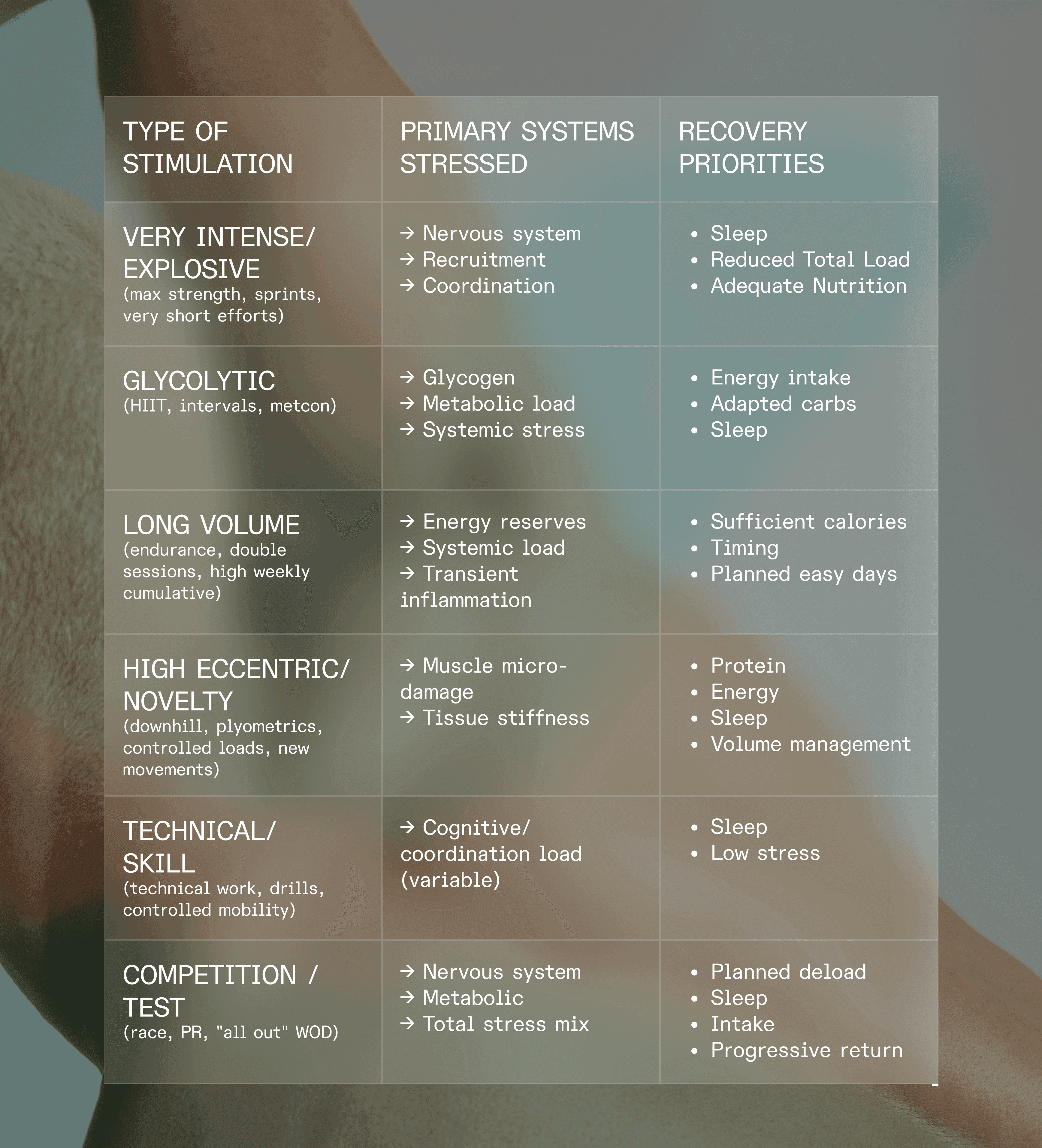
Why these differences matter
Because recovery is not a one-size-fits-all protocol.
It must be calibrated to the type of stimulation: one session may leave little soreness but be very costly on the nervous system, while another may primarily deplete your energy reserves.
Conclusion: don't plan your recovery based solely on volume. Plan it based on your goals and your sessions.
Revocery is an active physiological process
A common mistake is thinking that simply not training is enough to recover.
You can be completely inactive and not recover properly.
Why?
Because recovery requires your body to rebuild, repair, restore, regulate. This process requires specific resources that you must provide.
Here are the essential resources and the most common mistakes:
EN_Newsletter #1 Récupération03.png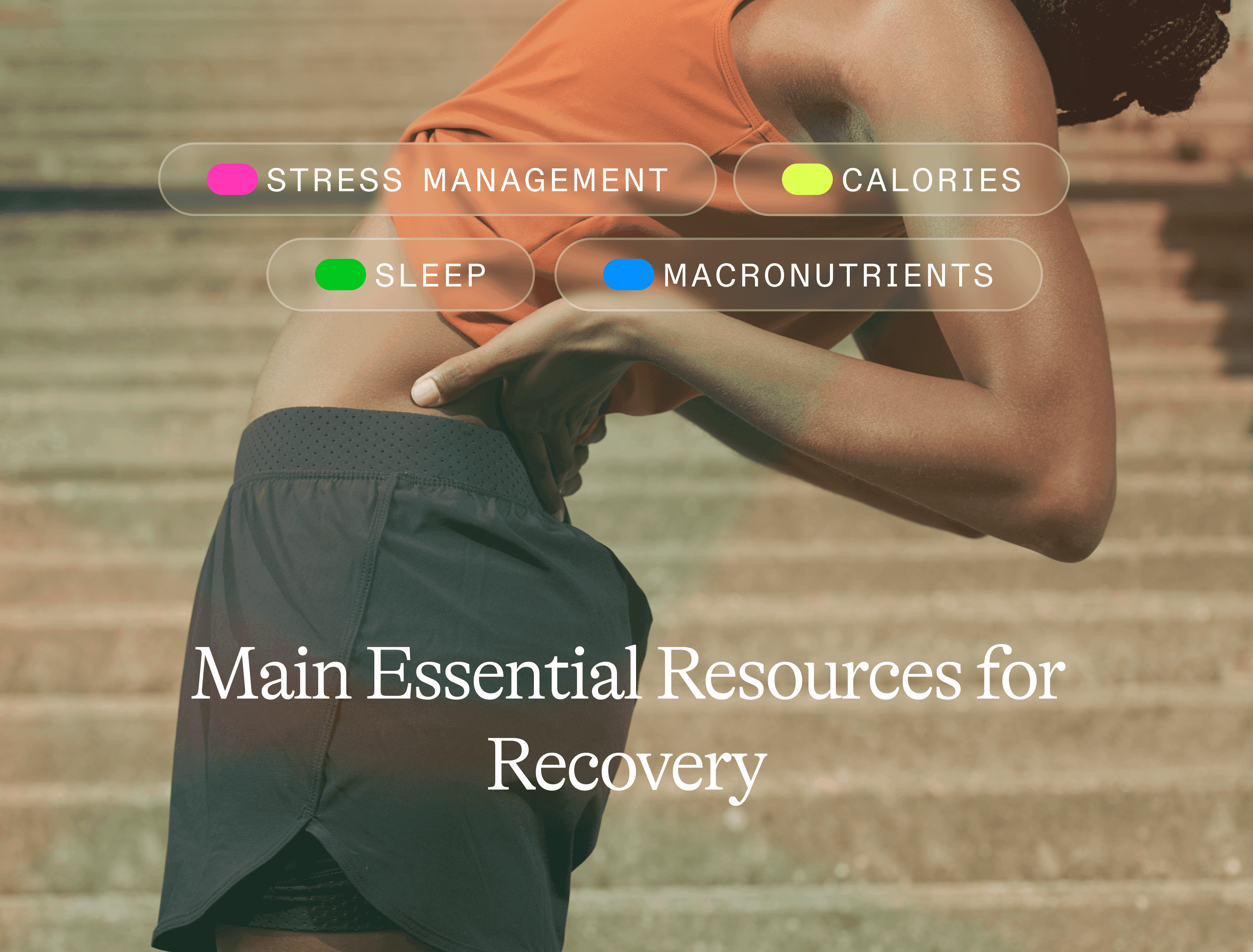
1. Energy: The Rebuilding Material
Your body needs calories, protein, carbohydrates, and micronutrients to rebuild muscle tissue, replenish glycogen stores, and synthesize new proteins.
Undereating is common among athletes.
Without sufficient energy intake, your body draws from its reserves to maintain vital functions. Recovery is compromised, adaptation doesn't occur, and you accumulate fatigue instead of progressing.
Even on rest days, your body rebuilds. Tissue repair, nervous consolidation, and hormonal regulation are energy-expensive processes. If you don't eat enough, you don't support these mechanisms.
2. Sleep: The Central Lever of Recovery
Sleep is when your body performs much of its recovery.
During sleep, your body regulates hormones, repairs tissues, restores neurotransmitters, consolidates nervous adaptation, and modulates inflammation.
Sleeping less than 7 hours per night, or having fragmented, poor-quality sleep, directly impacts your recovery capacity.
Sleep conditions hormonal regulation and adaptation.
You can find our tips for improving sleep in a previous edition (link).
3. Stress Management: Nervous and Hormonal Balance
Your body doesn't differentiate between training stress, work stress, and family stress. Everything adds up.
Each stress source can elevate cortisol, activate your sympathetic nervous system ("action" mode), and mobilize your internal resources.
Ignoring cumulative stress can lead to chronic overload.
Possible consequence: your cortisol remains elevated for extended periods. This chronic excess blocks hormonal recovery, maintains inflammation, and degrades sleep quality.
Hormonal recovery depends on your ability to regularly activate the parasympathetic nervous system, "recovery" mode. If you're constantly in sympathetic mode (action, alert, stress), your body cannot shift toward repair and reconstruction.
Learning to listen to your body
Each athlete recovers differently based on metabolism, training level, age, daily stress, and genetics.
Theoretical timelines are benchmarks — not absolute truths.
That's why learning to listen to your body's signals is essential.
Combine objective indicators and subjective signals:
Objective:
Biomarkers (cortisol, testosterone, CRP, ferritin)
Heart rate variability (HRV), measures the variation in time between each heartbeat. The higher it is, the more balanced and recovered your nervous system.
Resting heart rate upon waking
Sleep quality (duration, phases, awakenings)
Subjective:
Motivation
Mood, irritability
Perceived energy
Appetite
If multiple signals are negative, your body is telling you it hasn't finished recovering.
Optimized recovery is an active strategy that provides necessary resources and adapts in real time to your body's signals.
What's next?
In the second part, we move to concrete solutions and recovery strategies.
If you want to go deeper, listen to Lucis podcast episode with Marion Paret (naturopath and sports physical therapist), where we explore invisible barriers to performance and how to build a recovery strategy adapted to your reality.
The information provided is for educational purposes only and does not replace medical advice.
REFERENCES
Bishop, P. A., Jones, E., & Woods, A. K. (2008). Recovery from training: a brief review. The Journal of Strength and Conditioning Research, 22(3), 1015–1024.
Fullagar, H. H. K., Skorski, S., Duffield, R., Hammes, D., Coutts, A. J., & Meyer, T. (2015). Sleep and athletic performance: the effects of sleep loss on exercise performance, and physiological and cognitive responses to exercise. Sports Medicine, 45(2), 161–186.
Halson, S. L. (2014). Monitoring training load to understand fatigue in athletes. Sports Medicine, 44(Suppl 2), S139–S147.
Ivy, J. L. (1998). Glycogen resynthesis after exercise: effect of carbohydrate intake. International Journal of Sports Medicine, 19(Suppl 2), S142–S145.
Kellmann, M., et al. (2018). Recovery and performance in sport: consensus statement. International Journal of Sports Physiology and Performance, 13(2), 240–245.
Meeusen, R., Duclos, M., Foster, C., et al. (2013). Prevention, diagnosis, and treatment of the overtraining syndrome: joint consensus statement of the ECSS and the ACSM. Medicine & Science in Sports & Exercise, 45(1), 186–205.
Plews, D. J., Laursen, P. B., Stanley, J., Kilding, A. E., & Buchheit, M. (2013). Training adaptation and heart rate variability in elite endurance athletes: opening the door to effective monitoring. Sports Medicine, 43(9), 773–781.
Written by Anaïs Gautron
More insights, straight to your inbox.
New articles on biomarkers, performance, and wellness — no noise, just substance.


